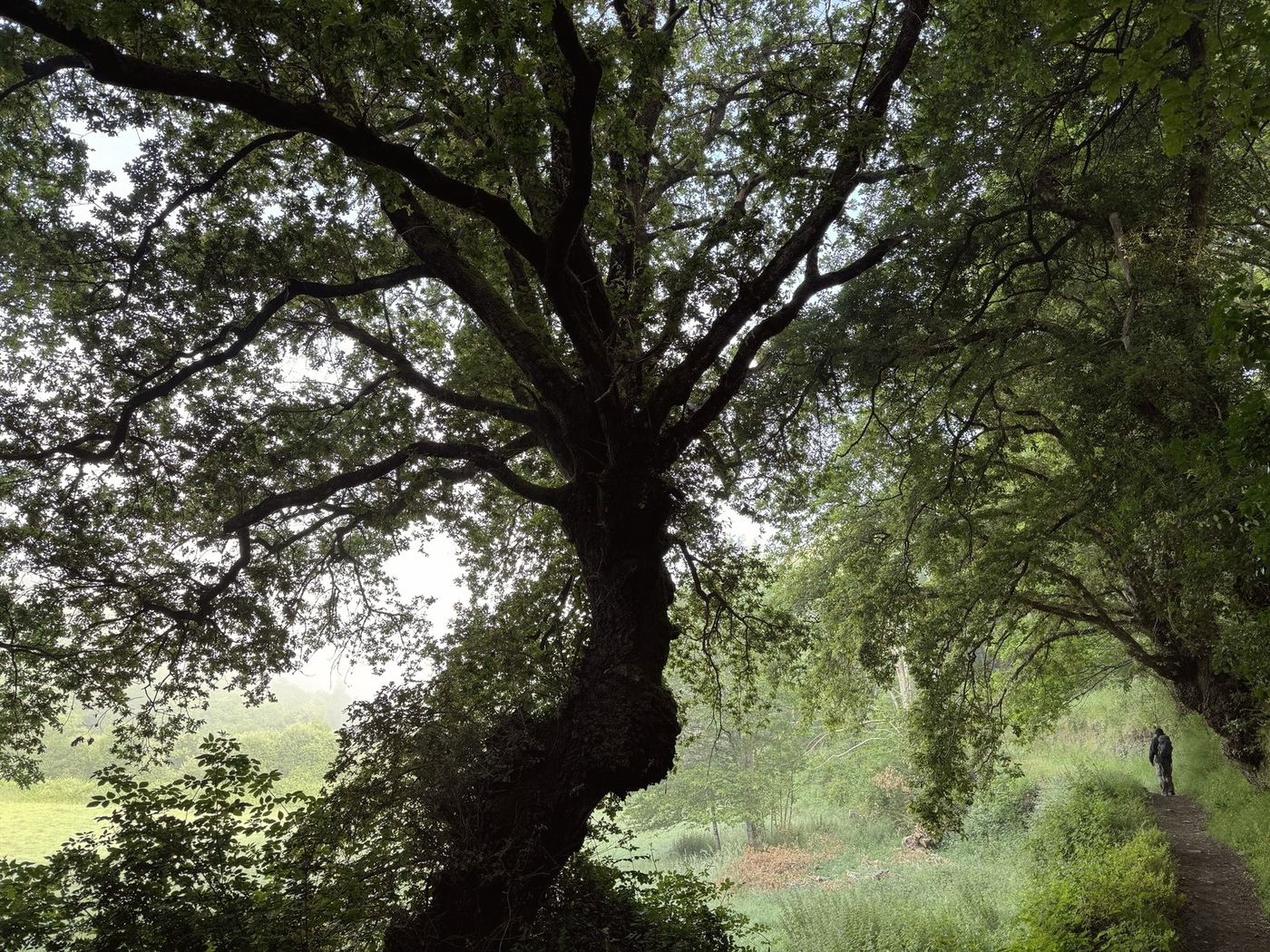
Some of the Spanish chestnuts along the Camino have stood for eight hundred years.
They have seen every kind of pilgrim pass beneath their branches. They are still seeing.
The kit you are about to read is small. The journey is ancient. Both belong to you now.
— Roxana Pérez Méndez
This document teaches you how to assemble a small medical kit for walking the Camino de Santiago. It is not a list of products to buy from us. It is a list of items the evidence supports, the conditions a pilgrim is most likely to encounter, and the deliberate restraint about what belongs in a pilgrim's pack at all.
Some items you should pack from home before you leave. Some are easier and cheaper to buy on arrival in Spain. A few are sourced as needed during the Camino, from a Spanish pharmacy (farmacia) or apothecary (droguería). Each entry below tells you which category an item belongs to, what it is for, and what to ask for at a Spanish counter.
Where a clinical decision is involved, this kit defers to The Blister Guide, available free at alongthecamino.com. The Guide carries the mechanisms and the protocols; this document carries the materials.
A note on Spanish pharmacy vocabulary
Spanish pharmacies stock two visually similar but functionally different products, and the principle that decides which one you want is older than either of them: healthy unbroken skin has its own antimicrobial defenses. The intact stratum corneum, the skin's slightly acidic surface (the acid mantle), and the resident microbiome together form a barrier that resists infection on their own — as long as we don't cover them unnecessarily. The right dressing is the one that respects this principle.
Tirita (TEE-ree-tah)
The everyday Spanish word for a small adhesive strip, equivalent to a band-aid in English. A tirita is a flat plastic or fabric strip with a tiny absorbent center, designed for very minor surface cuts and scrapes. It is the wrong tool for both ends of the problem. Over intact skin, the occlusive adhesive traps moisture and disrupts the skin's own antimicrobial function — covering what was already protecting itself. Over a draining blister or open wound, the adhesive does not seal a continuous barrier around the absorbent pad; under sock friction it lifts within hours, and the wound is exposed to sweat, dirt, and the bacteria of the shoe interior. Do not ask for tiritas for blister care on the Camino.
Apósito adhesivo (ah-POH-see-toh ah-deh-SEE-voh)
The precise medical term for an island dressing: a sterile absorbent pad surrounded by a sealing adhesive border. The seal is the point. It forms a continuous barrier between the wound and the environment, contains exudate inside the pad, holds the pad in place under sock friction, and protects against bacterial contamination — taking over the protective work that intact skin would have done on its own. An apósito adhesivo is the right dressing only when the skin's own barrier has been broken — a blister that is draining, weeping, or already deroofed; a cut; an abrasion. Over intact skin it is unnecessary and counterproductive. Ask for apósitos adhesivos, or by brand name: Cosmopor estéril or Hansaplast Sensitive XL.
The principle in one line: cover wounds, not skin. If the skin is intact and not yet damaged, leave it alone — let it do the work it was made for. If the skin's barrier has been breached, use the right dressing to take over until the barrier rebuilds itself. A pilgrim who covers everything indiscriminately with tiritas ends up with macerated skin under the adhesive and an unsealed blister leaking into the sock. The wrong product, used at the wrong time, is sometimes worse than no product at all.
Pack from home before you leave
Items unavailable, more expensive, or specifically supported by evidence
Two electrolyte powders
Sustained exertion in heat depletes sodium, potassium, and water faster than thirst alone tracks. A daily electrolyte drink during a long walking day helps maintain hydration balance and may reduce muscle cramping. Pack two sachets minimum; you can buy more in Spain.
One pack of paracetamol
For aches and minor pains not relieved by rest. Paracetamol acts on pain perception without the gastrointestinal and renal risks that accompany the NSAIDs. Adult dosing follows the package label.
One face mask
For enclosed transit — planes, trains, long-distance buses — and for crowded indoor spaces where an airborne illness can interrupt a Camino before it begins.
Two KT Tape strips (or kinesiology tape)
Elastic kinesiology tape, applied per the manufacturer's instructions, can provide temporary symptomatic support for a sore joint or muscle during walking. The mechanism is debated in the sports-medicine literature and the evidence for benefit beyond placebo is limited. Treat the strips as short-term comfort rather than cure, and consult a fisioterapeuta or médico if pain persists.
Two alcohol pads
For sterilising the tip of scissors or a needle before any contact with the skin. See The Blister Guide, Chapter 7, for the field drainage protocol.
Two benzalkonium chloride towelettes
A first-aid antiseptic for cleaning the skin around minor cuts, scrapes, or blisters before dressing. The standard sequence: wash the area with soap and water, dry it, then wipe with the towelette before applying any tape, hydrocolloid, or other dressing.
Two ENGO patches (PTFE friction-reduction patches)
Low-friction PTFE (Teflon) patches that adhere to the inside of the shoe — never to the skin — at the point where the foot is being shear-loaded. The location of an actual blister tells you where to place the patch on the shoe interior. The Blister Guide, Chapters 4 and 5, explains the shear mechanism these patches address.
One small roll of paper surgical tape
Paper surgical tape applied selectively to known hot spots before walking has moderate evidence supporting its use. The 2017 Wilderness Medical Society systematic review judged paper tape "may be effective" with moderate confidence. The 2016 Pre-TAPED II ultramarathon trial reported a 40% reduction in blister incidence when paper tape was applied to areas where the runner had previously developed blisters. Apply to clean, dry skin in a single layer. Trim the edges to round — squared corners peel. Test the application during training, never for the first time on the Camino itself.
An assortment of island dressings
Island dressings are sterile pads with sealing adhesive borders, used to cover a draining or healing blister during rest, in the shower, or while moving around town in the evening. Not designed for the loads and friction of a walking day; The Blister Guide, Chapter 7, names the dressings appropriate for use while walking.
The Blister Guide
The kit's clinical authority. When something appears on the foot, return to the Guide and locate the chapter that matches the blister's location and condition. Available free at alongthecamino.com.
Buy on arrival in Spain
Items easier, cheaper, or better-quality at a Spanish pharmacy or supermarket
Sunscreen, high SPF
The Camino crosses regions where sun exposure is significant even when the air is cool — particularly the Meseta in summer and the Galician coast in any season. Reapplication every two to three hours during walking is the practical minimum. SPF 50 is the recommended starting point.
Lip balm with sun protection
Coastal wind and sustained sun together produce chapping and burning that compounds across days. A balm with SPF, applied at each break, prevents what becomes painful by week two.
Small facial-hair scissors
For trimming paper surgical tape to fit the foot's contours — rounded edges below the toes, a long strip along the heel, whatever the affected area requires. Square corners peel; rounded ones stay.
As needed during the Camino
Items addressing conditions that may or may not arise — source from a farmacia only when needed
Arnica gel
A topical preparation traditionally used for soft-tissue inflammation. The peer-reviewed evidence for arnica is limited and mixed; pilgrims use it widely and report subjective relief, which is honest enough to share without overclaiming. Apply only to unbroken skin, around (not on) any blister, for aches and bruising.
Voltadol Forte (topical diclofenac gel)
A topical NSAID available without prescription in Spain. Useful for short-term symptomatic relief of muscle and joint pain. If you are also taking oral NSAIDs (see ibuprofen below), the systemic dose accumulates — ask a farmacéutico before combining.
Ibuprofen
An oral NSAID for inflammation and pain. Useful for short-term symptomatic relief; not appropriate for masking acute pain across many walking days. Sustained NSAID use carries gastrointestinal, renal, and hepatic risks that compound with dehydration and continued exertion. If pain persists beyond two or three days, ask a hospitalero to point you toward a centro de salud, a fisioterapia, or a farmacia — the Spanish primary care network is unusually accessible to pilgrims, and the right help is rarely far.
A sterile needle
For aspirating a tense, painful, or large intact blister per The Blister Guide, Chapter 7. The Guide explains when aspiration is indicated, when an intact blister should be left alone, and when the situation requires a clinician rather than the kit.
Apps to download before departure
A language app for Spanish
The Camino is conducted in Spanish (castellano) — signage, albergue check-ins, menú del peregrino orders, pharmacy conversations. Galician is a regional language but every Galician speaks Spanish too; you will not encounter a Galician-only speaker on the Way. Pack a basic Spanish phrasebook or app — Duolingo, SpanishPod101, or a simple offline phrasebook will more than cover what a pilgrim needs. Pilgrims walking the Camino Português will additionally need basic Portuguese for the Lisbon and Porto sections before crossing into Spain.
Gronze.com and Gronze Maps
Gronze.com is the canonical Spanish-language Camino planning resource — used by most Spanish pilgrims and increasingly by international ones. The website (in Spanish) lists every stage, every albergue, elevation profiles, and current conditions. The companion app Gronze Maps (free, iOS and Android, available in Spanish and English) brings the same data on-route with offline map use. Both are produced by Gronze Caminos S.L. in Terrassa, Spain.
Camino Ninja
Free, ad-free, anonymous app with offline accommodation and route information, exact distance and elevation calculations, and a Stage Planner for day-by-day journey planning. Over 100,000 pilgrims used it in 2025. Available on iOS and Android.
Wise Pilgrim and Buen Camino
Both publish route guides for the Camino Francés, Português, English, Norte, Primitivo, and other routes, available for purchase within the apps. Either is a usable trail companion; the choice is largely preference. Both work offline once route data is downloaded.
Offline Google Maps
Download offline map tiles for any region you'll walk through before departure, not from a Spanish café with marginal signal. Tile downloads are large and slow over uncertain Wi-Fi.
A practice of attention
The Camino begins where the body makes its quiet agreements with the world — at the sole. Each step is a conversation: skin, earth, time. Long before the first blister rises, the foot has already spoken. This kit listens.
It is not first aid. It is a practice of attention.
To walk well is to notice early: a warmth that lingers, a fold in the sock, a grain of sand insisting on its presence. Care begins there, in the almost-nothing. The pilgrim who tends to the small will go far. The one who waits for pain will learn, but at a cost.
Your feet are not tools; they are thresholds. They carry memory — of terrain, of weather, of yesterday's decisions. Preparation is a form of respect: drying, airing, adjusting, pausing. A few minutes given back to the body returns miles to the journey.
Blisters are not failures. They are messages written in friction and time. Read them early. Answer with patience. The Camino is generous to those who respond rather than react.
Walk as if you intend to arrive, not just to endure. Let each step be deliberate, even when it is light. Even when it is tired.
This kit offers materials, but more importantly, it offers a stance: notice, tend, continue. The Way does not demand perfection — only presence.
Care for your feet, and they will carry you not just across distance, but into the deeper rhythm of the Camino itself.
notice, tend, continue.